

VAL (The Virtual Airport Liaison)
THE CHALLENGE
Following the successful deployment of our in-house kiosk network, we were invited by Amazon Web Services (AWS) to co-develop a cutting-edge generative AI chatbot system. The goal was ambitious: reduce passenger friction by creating a real-time, context-aware terminal liaison capable of answering highly complex customer queries instantly.
The engagement started under extreme high-pressure conditions—I was given exactly three days to conceptualise a complete terminal AI product, design the foundational presentation layer, and present it directly to the Amazon leadership team at the AWS Headquarters in London
ROLE
Head of UX
Spearheaded the rapid 3-day product ideation sprint, owning the executive pitch and strategic vision presented at AWS Headquarters. Led the cross-functional UX architecture workshop alongside AWS data engineers, mapped conversational intents to physical passenger stress states, and directed the UI layout deployment across our multi-device kiosk and mobile ecosystems.
The Approach
Rapid Executive Ideation: Designed a comprehensive product vision, interaction framework, and terminal UX blueprint within a 72-hour window to secure the AWS co-development initiative.
Agentic Architecture Collaboration: Partnered closely with AWS engineers to structure the agentic architecture fueling the LLM. We integrated localised, real-time data agents—plugging the core model directly into live weather data, flight information APIs, and our three-airport web databases.
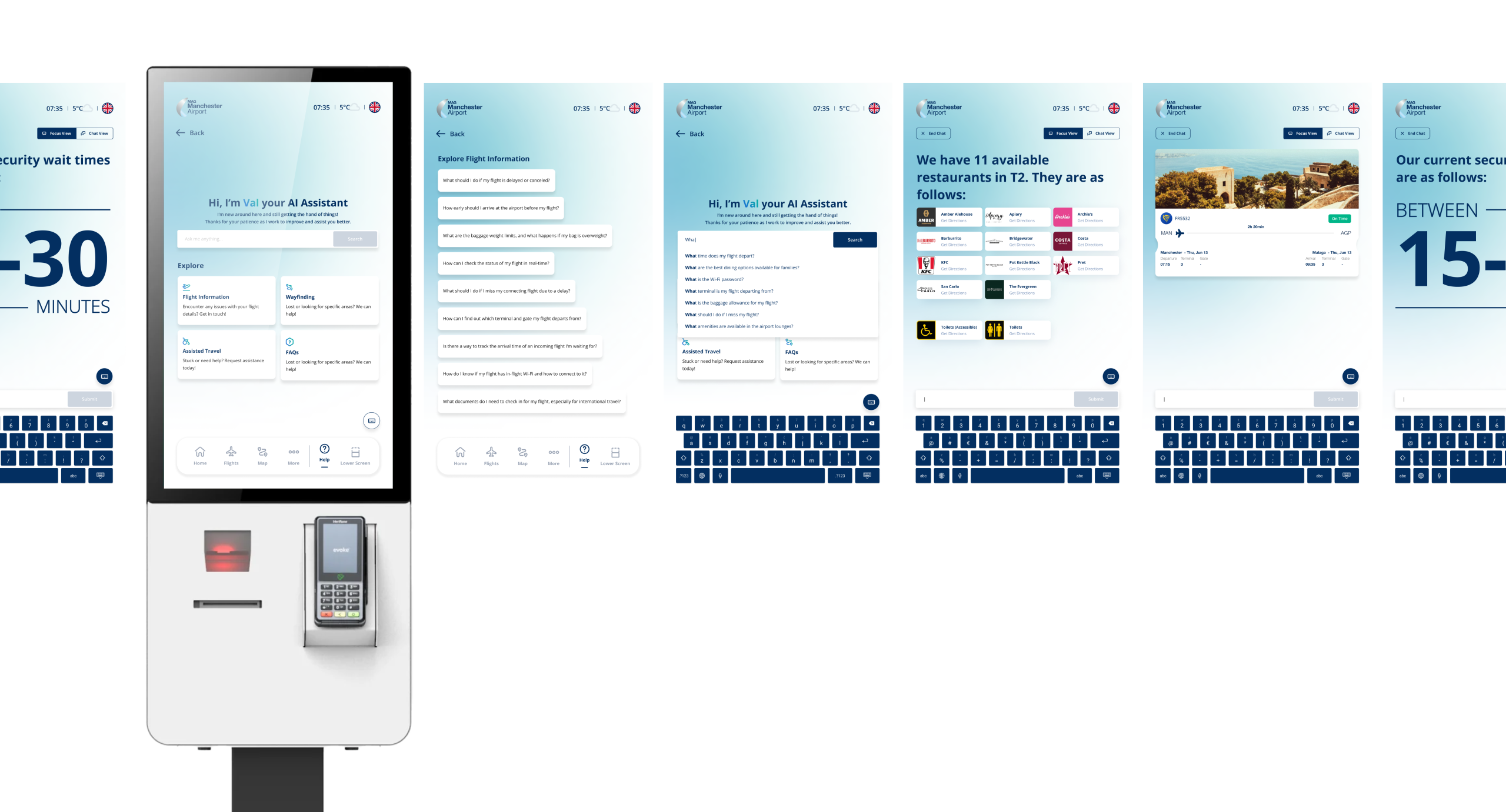
Multimodal, Omnichannel Delivery: Designed a highly scalable natural language interface optimized to work flawlessly across completely distinct viewports—deployed seamlessly onto physical airport kiosks and our mobile digital customer platform (DCP).
The Impact
True Contextual Intelligence: Created an autonomous, multilingual digital companion that eliminates cognitive load by synthesising flight metrics, maps, airport rules, and retail insights into natural language answers.
Scalable Terminal Utility: Rolled out a continuous, 24/7/365 self-serve platform capable of dynamically scaling to match seasonal terminal demands across Manchester, London Stansted, and East Midlands airports.
Future-Proofed Omnichannel Core: Successfully expanded the utility of our in-house DXP framework, positioning generative AI as a core, reusable channel rather than an isolated terminal gimmick.
What the Passenger Wants to Know
Travellers navigating massive international terminals experience high cognitive friction. They are constantly looking for critical, disjointed points of information under strict time constraints. Working alongside AWS, we mapped out the core customer problem vectors into discrete, high-value queries that the conversational layer needed to handle instantly:
Terminal Navigation: “Where do I check in?” | “Where are the toilets?” | “Where is my gate?”
Passenger Assistance: “Where can I get assistance?” | “I’ve lost my luggage.”
Commercial & Logistics: “Where is the best burger?” | “Can I buy fast track security?” | “Is there a lounge?”
Operational Rules: “Can I buy fast Wi-Fi access?” | “How much duty-free can I buy?”
Key Design Pillars
01 / Natural Language & Contextual Synthesis:
Bypassed rigid, menu-driven legacy chatbots in favour of an LLM that converses naturally. By connecting dedicated agents directly to our live airport APIs and websites, VAL doesn’t just link to pages; it ingests complex data variables and delivers an immediate, single-sentence response tailored perfectly to the passenger’s stress state.
02 / Cross-Device Multimodal Design:
Engineered a responsive conversational framework built for diverse, cross-channel hardware environments. The UI maintains a strict system of design tokens and accessibility guardrails, functioning as an intuitive full-height interaction map on an Evoke Creative terminal kiosk, while compressing beautifully into a sleek, thumb-optimised chatbot view on our mobile web platform.
03 / Hyper-Localised 24/7 Availability:
Designed to serve as a continuous operational utility that requires zero airport staffing resources. The software features deep multi-language localisation parameters, ensuring international travellers can type or speak in their native tongue and instantly receive terminal-specific, context-aware updates.

Impact & Key Performance Metrics
To measure the true efficacy of the in-house DXP rollout, we tracked live engagement metrics across our terminal hardware network. The data validated a massive passenger appetite for self-serve utility, proving that bringing the build in-house was both operationally sound and highly scalable.
~5,500 Average Monthly Kiosk Sessions: Demonstrating sustained, continuous passenger engagement across both landside and airside pairs throughout the terminal journey.
~525,000 Average Monthly Click Events: Proving extremely deep interaction density per session as users actively navigated terminal layers, deep-dive itineraries, and localised services.
~70% Self-Reported Success Rate: Close to three-quarters of surveyed travelers explicitly verified that they successfully found the exact terminal information, flight update, or map route they were looking for natively on the kiosk interface.
Engagement Split by Feature Area
The live usage data clearly mapped out exactly where passengers focused their attention during high-stress terminal transitions:
Strategic Takeaway: Generating 20% of all total engagement from the VAL Chatbot shortly after its fast-follow rollout explicitly validated our strategic generative AI roadmap with AWS. It proved that conversational interfaces are a vital, highly utilised layer of modern physical-to-digital spatial design.